
Every asset you can trade sits somewhere on the same set of axes. Risk, cost, transparency, and how easy it is to understand what actually drives returns. Some products are plain. You buy a stock, you own a tiny piece of a business. You buy a simple bond, you are owed coupons and principal as long as the issuer survives.
Other instruments add layers. They bundle derivatives, swap one type of risk for another, or turn a continuous price path into a yes-or-no payoff. Sometimes that extra structure solves a genuine problem for a very narrow audience, such as a hedge fund or a company hedging a complex exposure. Sometimes it mainly solves a revenue problem for the provider.
The point here is not “never touch anything more complicated than a blue-chip stock”. It is more modest. There are products that consistently trip up ordinary traders and part-time investors, either because the odds are poor from the start, or because the way they are used in practice bears no relation to how they were designed.
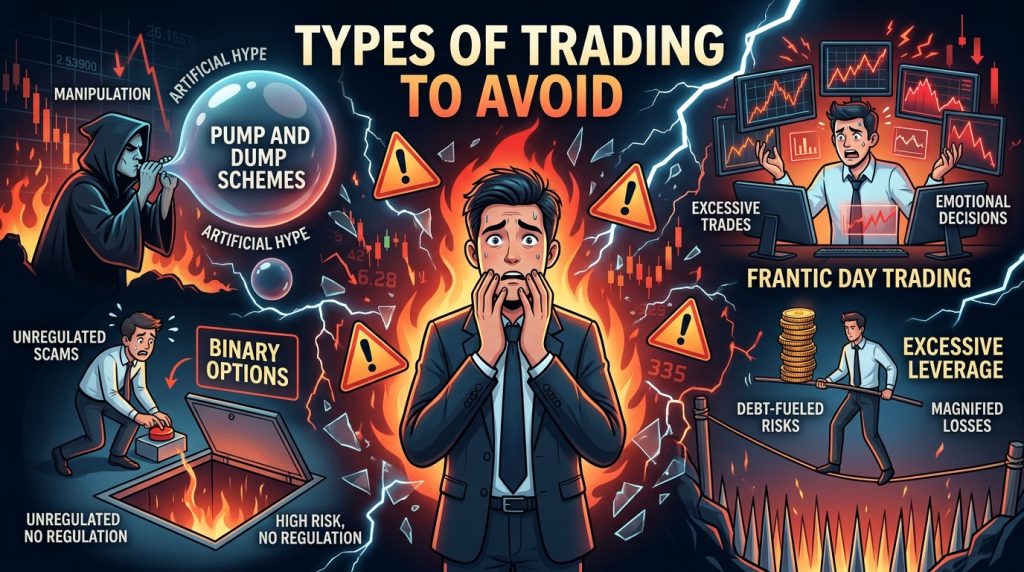
Binary options are high on that list. So are ultra short-term highly geared FX and CFD contracts, certain exchange traded products, penny stocks and some structured notes aimed at households. Looking at why these keep causing problems is a useful way to decide what you want to stay away from, or at least treat with extreme caution.
Binary options: fixed odds disguised as trading
How the payoff actually works
A binary option is a simple bet written in trading language. You pick whether a market will be above or below a level at a set time. If you are right, you receive a fixed payout. If you are wrong, you lose your stake. There is no sliding scale. A one-tick win and a fifty-tick win pay the same.
Take a basic high or low contract on a forex pair. The platform might say “payout 80 percent” for a ten-minute bet on EURUSD. You stake 100 units. If the price finishes in your favour at expiry, you receive 180 back. If not, you receive zero. Your maximum loss is 100. Your maximum gain is 80.
To break even over a long run of trades you need to win more often than you lose, because each loss is larger than each gain. With an 80 percent payout your breakeven win rate is just under 56 percent before any other costs. Short expiries are close to coin flips around the current price. That leaves a built-in edge to the house even before you make human mistakes.
Other styles such as one-touch, no-touch or range binaries look different on the screen but share the same structure. Defined stake, all-or-nothing outcome, payoff ratios that require you to be right more often than you might expect.
Why most traders sit on the wrong side of the math
In theory, if you had a proven method that called short-term direction correctly at a high rate, you could treat binaries as another way to express that edge. In practice, most people using these platforms do not have that method. They have some chart patterns, hunches and a strong appetite for quick feedback.
The combination of a negative payout ratio, short timeframes and full loss on each miss is brutal. A small losing streak wipes several winning trades. Because the result of every bet is either “win big” or “lose everything staked”, the temptation is to chase. Stake size creeps up when you feel behind. One bad session can cut through an account that took months to fund.
There is also the fact that you cannot manage the trade once it is live in any meaningful way. With spot FX or CFDs you can move stops, scale out or decide to cut early if the story changes. With a binary you mostly sit and watch a countdown. If price flips against you near expiry, there is nothing to do except accept the full hit.
From a long-run, probability-based view, binary options combine the worst of casino games and short-term trading. You face random price noise, platform costs and a payoff table that makes the breakeven point sit in the wrong place.
Extra issues with offshore binary brokers
Large parts of the binary options business moved offshore after regulators in bigger centres started to clamp down. Many binary platforms are registered in light-touch jurisdictions. Some have little or no meaningful supervision.
On those platforms, the “broker” is the house. It sets payout ratios, controls the feed used to judge whether a contract finished in or out of the money, and decides how easy it will be to withdraw funds. There is no independent exchange or clearing body in the middle.
That brings extra problems beyond the math. Price ticks near expiry can be disputed. Records can be hard to obtain. Bonus schemes often come with clauses that let the firm refuse payouts until trading volume targets are hit. In extreme cases, accounts with long winning records find their trades cancelled or restricted with vague references to “abuse” of terms.
Even if a given firm behaves honestly, you still take full counterparty risk. If it has banking issues, gets hacked, or simply closes down, there may be no realistic way to get money back. That is a different level of danger than using a regulated stock or futures broker where client money sits under stricter rules.
Put together, binary options are best seen as something to avoid if you are trying to grow capital over years rather than looking for a fast emotional hit.
You can learn more about binary options and the dangers of binary options by visiting BinaryOptions.net. Site dedicated to binary options and to make the trading as safe and transparent as possible
Very short-term high-leverage FX and CFD products
Tiny moves, big notional, fast account swings
Spot forex and CFDs are not inherently “bad” products. Plenty of disciplined traders use them to express views with modest margin and clear risk limits. The trouble starts when you mix very short timeframes with high gearing and treat the whole thing as a way to turn a small stake into something much larger in a short span.
Retail brokers often advertise position multipliers that turn a small account into exposure many times larger. A move of half a percent in the underlying can then produce a ten percent swing in equity, sometimes more. On a five-minute chart that half percent is not rare. It is ordinary noise.
This makes day trading look attractive. You can open and close positions all day, aiming to skim small moves. On a clean spreadsheet, taking a few pips repeatedly at high notional size looks like an easy route to growth. In live conditions with slippage, changing spreads and human error, it is harder.
Short-term FX and CFD trading with heavy gearing often leads to the same pattern. Quick gains, confidence up, size increases, then a normal losing streak or a surprise piece of news pushes positions into margin trouble. Forced liquidations lock in losses right at the worst moment.
Why short timeframes and leverage are a rough mix for most people
Short timeframes amplify every weakness in behaviour. If you are tired, stressed, bored or under financial pressure, those emotions can filter straight into decisions every few minutes. You end up trading to feel active, not because you have a clear setup.
Leverage then multiplies the impact of that behaviour. A small slip in discipline, like removing a stop “just this once” or doubling size to “get back to even”, can turn a small drawdown into an account-level event.
There is also the boring math of transaction costs. Every round trip in a CFD or FX trade pays the spread and, on some accounts, commission. The more often you trade, the bigger that constant drain becomes. To come out ahead you need a real edge after all those frictions. Most fast retail strategies do not have one.
Using these instruments on higher timeframes with modest gearing and low trade counts is one thing. Using them as a fast game with high multipliers and dozens of trades per session is quite another. The second pattern is what traps many people, and it is well worth avoiding.
Leveraged and inverse ETPs for “set and forget” investors
Daily rebalancing and path dependence
Leveraged and inverse exchange traded products (ETPs and ETFs) are often bought by people who want “two times” or “three times” the move of an index, or the mirror image when markets fall. The detail that gets missed is that most of these funds target that multiple on a daily basis, not over months or years.
To hit a daily target, the fund rebalances at the end of each session. Over time that leads to path-dependent returns. If the index swings up and down, the fund adjusts exposure after each move. The arithmetic of those swings can mean that even if the index ends a period flat, the leveraged ETP ends down.
In quiet, persistent trends, a geared fund can track something close to the advertised multiple for a while. In volatile, choppy conditions, the compounding effect can drag performance away from what a casual holder expects. Inverse versions can suffer even more in sharp rallies.
Why they rarely match what buyers think they do
Many retail holders treat these funds as simple magnifiers. They buy a three-times product on an equity index and assume that if the index is ten percent higher in a year, their fund will be roughly thirty percent higher. That is not how the math works except in very tidy markets.
If the index path during the year is wild, the fund’s path can lag badly. In some cases, a leveraged bull and a leveraged bear fund on the same index can both lose money over a period where the underlying finished not far from where it started. That surprises people who did not read the small print.
Fees also bite. Leveraged and inverse products tend to carry higher expense ratios than plain index trackers. That adds another slow drag.
These funds can be useful tools for traders who understand daily targeting and who use them for short tactical holds. They are far less suitable for long-term “buy and park it” use in a retirement account. If your aim is to own equity exposure over years, a plain, low-fee index tracker is usually closer to what you think you bought than a leveraged or inverse product.
Penny stocks, micro-caps and illiquid shares
Promotion, slippage and getting trapped in trades
Penny stocks and micro-caps appeal because of the upside stories. Small company, low share price, the idea that one big contract or announcement could multiply the value. For traders on social media, a stock that goes from ten cents to thirty cents in a week is a badge of honour.
What these stories leave out is how thin the trading often is. Bid and ask spreads can be wide. The posted size at each price may be tiny. If you buy even a modest amount and then try to sell, your own order can push the price down. That gap between the last traded price and what you can actually get out at is slippage, and it can be large.
Promotion is another issue. Many small caps are the subject of aggressive newsletters, chat room campaigns and, in bad cases, outright pump-and-dump schemes. Early buyers hype the story, liquidity arrives, price lifts, and then the same early buyers quietly sell into that demand. Late arrivals are left holding stock that does not have real support once the noise fades.
Getting trapped is common. On the way up, it feels like everyone wants in. On the way down, bids disappear. You can see a price on a chart but find that hardly anyone is prepared to buy more than a token size at that level.
Why basic analysis is harder than it looks
On the face of it, small companies should be easier to analyse. Fewer business lines, simpler balance sheets. In practice, the opposite is often the case. Information can be sparse. Reporting standards may be weaker. One key customer or lender can dominate the entire story, and access to management is usually worse than at larger firms.
Many micro-caps are early stage ventures with little or no revenue. Valuing a story based on hopes rather than cash flow is hard even for professionals with sector knowledge and direct contact with management. Doing it from public filings and price charts is harder again.
None of that means nobody should ever touch small stocks. There are specialists who focus on this segment and take the time to do serious work. For most part-time investors flicking through tickers in an app, though, penny stocks are closer to lottery tickets than to thought-through investments. As a category, they deserve a spot on any personal “treat carefully, or avoid” list.
Complex structured products sold to retail
Capital protection, barriers and hidden fees
Banks and brokers often offer structured notes to households. Marketing phrases include “capital protected”, “income with potential upside” and “barrier” features. Under the hood, these instruments combine a bond with one or more options on an index, basket of stocks or other asset.
A common pattern is a note that promises to return your original capital at maturity, plus some coupon or equity-linked gain, as long as an index does not fall below a barrier. If the index stays above the barrier, you get an agreed payout. If it falls through, your capital can be cut. Variants add autocall features, where the product redeems early if markets behave a certain way, or reverse convertibles that pay high coupons in exchange for taking on equity downside risk.
Pricing these structures involves option valuations, credit spreads and bank funding costs. Retail buyers often see only the headline yield and the barrier level. Fees, embedded margins and anything the issuing bank earns from hedging the option are less visible.
Because the note contains a bond, the sales pitch leans on safety. The word “protection” appears a lot. The real question is who you are protected from. You may be insulated from small market dips, but you are exposed to the issuing bank’s credit and to large market falls that push through barriers.
Why payoff diagrams can mislead
Term sheets include payoff diagrams: neat lines and kinks that show what happens at maturity for different index levels. On paper the picture can look reassuring. Losses kick in only after a big drop, and before that you see a flat or rising line.
Real life is messy. Barriers can be monitored continuously or at set dates. That detail matters. A brief crash that touches the barrier and then reverses can wreck the protection feature even if the index ends the term not far from where it started. Early redemption features can end the product just before the payoff you hoped for would have appeared.
Liquidity is another concern. Many structured notes are not easy to exit at fair value before maturity. Secondary markets exist but spreads can be wide, and pricing is dominated by the issuing bank. If your life changes or markets move in a way that makes you uncomfortable, getting out cleanly is not guaranteed.
Structured products are not automatically “bad”. Used by people who understand the embedded options and credit, they can solve particular problems. Sold as simple income or safe growth to households who mainly see the headline rate, they have a track record of delivering surprises at the worst times.
If you are not prepared to read long term sheets carefully and think about credit and option behaviour, it is often easier to avoid this segment altogether and focus on plain funds and securities.
How to use this in practice without being paranoid
It is easy to swing from “I’ll trade anything” to “everything is rigged, I’ll stick my money under the mattress”. Neither extreme helps much. The useful middle ground is knowing where the odds and structures are quietly stacked against you and deciding that your time and capital are better spent elsewhere.
Binary options, ultra short term highly geared FX and CFD bets, leveraged and inverse ETPs used as long-term holdings, speculative thin stocks and complex structured notes all sit in that problem zone for a large share of ordinary traders and investors. They share a mix of poor average odds, high fees, hidden behaviour, or payoffs that do not match how buyers actually use them.
You do not need these instruments to build wealth or to trade thoughtfully. Shares, plain bond funds, simple index trackers, unleveraged spot FX for hedging, and listed futures or vanilla options for those who really want them already give more than enough room. Staying away from the worst offenders is less dramatic than chasing the next clever product, but over years that quiet filter does a lot of work for you.
This article was last updated on: March 5, 2026